In the digital age, businesses can effectively communicate with their target audience and achieve their objectives through advertising. However, it takes careful planning and execution to ensure success. One crucial consideration is identifying your audience and where they are. This is key to determining the best platform and format to reach them. But how can you effectively reach your audience and deliver a message that resonates with them? In this article, we’ll explore eight essential factors to consider for your advertising campaign.
Start with a plan: Define your objectives, success metrics, timing, budget, and target audience. Without a plan, you may not achieve your business objectives.
Identify your audience: Determine who they are, their behaviors, patterns, psychographics, and preferences. You can then find out where they are, be it on LinkedIn, Reddit, People, or Forbes.
Understand your audience: Delve deeper into what appeals to them, and experiment to see what works. This can guide the creative, copy, and delivery of your message.
Be authentic to your brand: Stay true to your brand, product, and consumer. Don’t convey a message that is not in line with your brand, as this can confuse your audience.
Fine-tune your message: The message is everything. Ensure that it appeals to the audience you’re targeting.
Ensure creative and copy work together for your brand: Blend the message and art to present a holistic picture of your brand. This strategy is true to the brand, product, and potential customer.
Work with the right people: Choose creative and media agencies that listen and work side-by-side with you as a partner. One size does not fit all, and sometimes a combination of agency and DIY work is just fine.
Measure your success: Factor measurement into your plan so you can track progress and point to indications of success. Depending on your campaign objectives, you can measure brand lift, leads, conversions, clicks, and more.
As an advertiser or business solution, ADAS (Ad Demand and Supply) can help you know and grow your audiences, making it easier for your business to thrive. When it comes to your advertising campaign, consider the above factors to ensure you effectively communicate your message to your target audience. Remember, a successful campaign requires careful planning, execution, and measurement.
Demand Side Platforms (DSPs) have revolutionized the way advertisers purchase ad inventory and reach their target audience. Programmatic advertising is a way of buying ad placements that is automated, using ad exchanges and other algorithmic software that allows for machine-driven buying of inventory. This article explains how DSP advertising works and what advertisers are really buying.
In this article, we’ll explore the definition of DSP advertising and programmatic advertising, the difference between DSP and Supply Side Platform (SSP), examples of DSPs, how DSPs make money, and a comparison between DSP marketing and Performance TV with MNTN.
Introduction
In the constantly evolving advertising world, technology is advancing at an unprecedented rate. Programmatic advertising and the tools that go along with it, such as DSPs, have made it easier than ever for advertisers to access ad inventory across publishers and reach their target audience. However, many advertisers still find it difficult to keep track of all the changes and technological advancements. This article aims to provide an in-depth understanding of DSP advertising.
DSP Advertising Definition and How it Works
A DSP is software that allows advertisers to buy ad impressions in an automated fashion. In simple terms, programmatic advertising has the same fundamentals as any kind of transaction – there is a buyer and a seller. DSP advertising is a tool used on the buying side, AKA the advertiser’s side, of the transaction when buying advertising impressions. This software allows advertisers to buy media placements across mediums, including display, video, mobile, and even Connected TV, as well as across different publishers.
Advertisers who use DSP advertising are able to set up their campaign, buying ad impressions from an ad exchange (a pool of impressions from various publishers) for a predetermined bid price. Additionally, they can use the DSP technology to target their audience, whether it’s by demographic (ex. Adults 18-34) or by interest (ex. Have purchased plant-based meat). DSPs use the bid price and audience targeting information to sift through inventory available from the ad exchange and select the best impressions available for your campaign.
Programmatic Advertising Definition
Programmatic advertising is a way of buying ad placements that is automated. Instead of the manual process of campaigns being bought, set up, and maintained by humans, programmatic advertising uses ad exchanges and other algorithmic software that allows for machine-driven buying of inventory.
Programmatic advertising allows advertisers to take ad buying into their own hands, allowing them to set up their campaign immediately and to track results in almost real-time. For publishers with ad inventory, it easily allows them to make these impressions available to advertisers without having to work with a multitude of companies directly.
The Difference Between DSP and SSP
A DSP definition can be better understood within the context of its counterpart – SSP. SSP stands for Supply Side Platform and is the other side of the transaction when it comes to programmatic ad buying. Publishers utilize a SSP to make their inventory available to advertisers, while advertisers use a DSP to plug into the ad exchange and purchase advertising.
The SSP allows publishers to add their inventory to exchanges and set a floor price, meaning that they can guarantee their inventory is sold for a minimum price that aligns with their business goals. So while advertisers use a DSP to try to get ads at the best (read: lowest) price for their desired inventory, publishers use SSPs to help ensure that they can sell their inventory at the highest possible price. The DSP and SSP work together to find a middle ground that works for both parties.
Examples of Demand Side Platforms
Now that we’ve answered the question “what is a DSP?” perhaps you want to check out a few concrete examples. Below is a list of some commonly used services:
These are just a few examples of DSPs in the advertising industry. Each DSP has its unique features and strengths, so it’s essential to do your research before deciding which one to use. It’s also worth noting that while DSPs are commonly used in advertising, they can also be found in other industries that require real-time data analysis and optimization, such as finance, healthcare, and telecommunications.
Demand-side platforms (DSP) and supply-side platforms (SSP) make the process of publishing an ad efficient and near-instantaneous. Gone are the days when ad buying and selling included manual insertion orders, sit-down meetings, and contracts.
So, what is a DSP, and how does it work? Let’s dive in.
What is a DSP?
Advertisers use a demand-side platform (DSP) software to purchase mobile, search, and video ads from a marketplace where publishers list their advertising inventory. These platforms provide a central location for advertisers to manage their accounts across multiple real-time bidding networks, such as Google Ads and Facebook Ads Manager, eliminating the need to log in to each network separately. The use of DSPs, along with supply-side platforms (SSPs), enables programmatic advertising, which streamlines the buying and selling of advertising inventory by automating the process through software.
What is programmatic advertising?
Programmatic advertising is the process of buying and selling ads with software and publishing those ads contextually based on complex algorithms. Most online advertising is done programmatically through real-time bidding and direct deals.
Real-time bidding
This advertising approach allows businesses to bid automatically for ad impressions that align with their objectives. You can select the audience you want to target with your ads and set your budget. The platform will then manage the bidding process on your behalf against other advertisers who are also targeting the same audience.
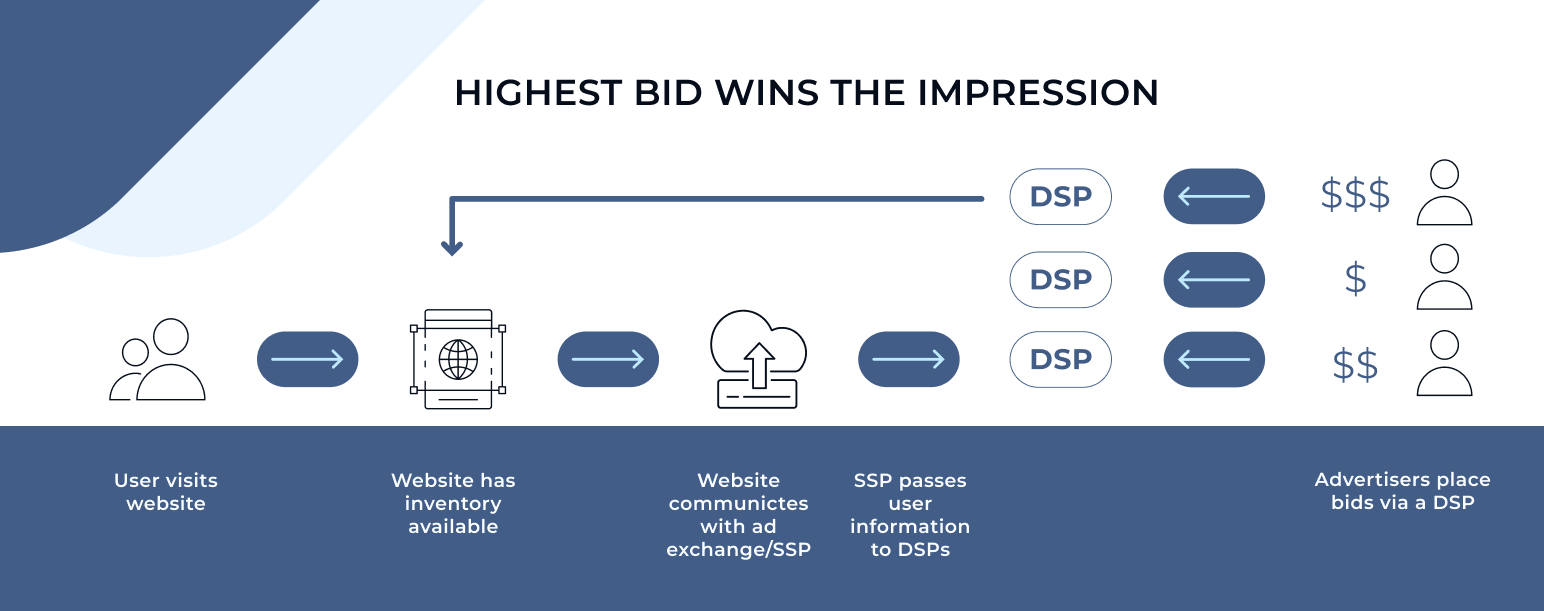
Here’s how it works: when a potential customer visits a page, like a Google search result for a particular product, algorithms kick in to determine the best ad to display in real-time. These algorithms leverage data such as browsing history, time of day, and IP address to determine the most relevant ad to display. The business that bids the highest for that particular impression based on this data wins the ad placement.
Programmatic direct
This kind of advertising is ideal for businesses that want guaranteed ad placements in premium locations. Homepages of big-name publishers, for example, will often sell their ad space via programmatic direct deals. The publisher provides the advertiser with details about its website visitors. If those visitors are the advertiser’s ideal audience, then the advertiser can choose to purchase a portion of publishing space for an upcoming campaign.
According to Statista, US advertisers’ programmatic ad spend is projected to grow from $106 billion in 2021, a 41% increase over 2020, to almost $142 billion in 2023.
Programmatic advertising is a rapidly growing industry, and demand-side platforms (DSPs) are playing a key role in this growth. DSPs allow advertisers to purchase, analyze, and manage ads across multiple networks from a single dashboard, giving them more control over their campaigns. In this article, we’ll explore how a DSP works, its benefits and drawbacks, and why businesses of all sizes should consider using this technology.
What is a Demand-Side Platform?
Demand-side platforms are third-party software that enable advertisers to purchase ad space across multiple networks, including display, mobile, and video. Unlike Google Display Network Manager or Facebook Ads Manager, which only allow advertisers to buy impressions on specific networks, DSPs are independent of individual networks. They give advertisers access to a range of ad exchanges, where they can bid on impressions in real-time.
How a DSP Works
To understand how a DSP works, it’s important to first understand the programmatic advertising ecosystem. There are two key players in this ecosystem: demand-side platforms (DSPs) and supply-side platforms (SSPs). DSPs give advertisers all the information they need to buy advertising from a publisher. They don’t own or purchase media directly from publishers, but instead communicate with an SSP through an ad exchange.
Supply-side platforms allow publishers to list their inventory on the ad exchange, and they communicate with DSPs about the details of an impression. When a user visits a website or app, the publisher’s ad server sends an ad request to the SSP, which responds with information about available ad inventory. The DSP then bids on this inventory in real-time, based on the advertiser’s targeting criteria and budget. If the advertiser wins the bid, their ad is served to the user.
Example of Programmatic Advertising
Let’s say a marketing manager visits your demo landing page. She didn’t request a demo, but she’s expressed interest in your product by visiting your page. This makes her more valuable to you than somebody who’s never visited your website or interacted with your brand.
In that case, your DSP will likely bid higher for her impression. Whether you win the bid will depend on how valuable this impression is to other businesses. Maybe this same person abandoned her cart on an ecommerce website. If that’s the case, the ecommerce website may bid more to serve an ad that gets her to the checkout page. It all depends on the budget of the bidder and the value of the impression.
Benefits of Using a DSP
Efficiency: If you’re managing campaigns across many networks, a DSP allows you to view and adjust all of your advertising from one dashboard. This enables marketers to reach and activate customers at scale.
Data: Many DSPs partner with third-party data providers to offer advertisers as much information as possible. Often it’s more than a single network can provide. Additionally, many DSPs allow customers to import their own data from a CRM or a DMP (data management platform).
Targeting: More data gives advertisers pinpoint targeting capabilities. Better targeting means more personalized ads and landing pages, which means a higher likelihood of conversion.
Support: Demand-side platforms will often provide support beyond the traditional help desk-style customer support of a single network.
High-quality inventory: DSPs will have access to the major networks and then some. If you’re after more premium inventory, a demand-side platform may be what you’re looking for. Some have more access than others, though, so it’s important to compare offerings before you pick one.
Drawbacks of Using a DSP
Cost: DSPs can require significant investment, so it’s important to understand the minimum monthly or campaign spend required before selecting an option. A managed DSP, such as The Amazon Managed Services DSP, may require $35,000 ad spend or more. A self-serve option may only require $3,000 – $12,000 for a campaign, but needs a greater investment of time to manage the process.
Factors to consider when choosing a DSP
Choosing a DSP requires careful consideration of several factors. Here are some important things to keep in mind:
Platform features and capabilities
The first thing you need to consider is the platform’s features and capabilities. Look for a DSP that offers advanced targeting and optimization features. Make sure that the platform can integrate with your existing tech stack and third-party tools.
Data access and quality
Data is critical in programmatic advertising, so it’s important to choose a DSP that offers access to quality data. Look for a platform that provides access to a wide range of data sources and can integrate with your own first-party data.
User experience
The user experience is important when it comes to managing your campaigns effectively. Look for a platform that offers a user-friendly interface and makes it easy to manage your campaigns.
Support and training
Implementing a new DSP can be a daunting task, so it’s important to choose a platform that offers excellent support and training resources. Look for a provider that offers phone and email support, as well as a knowledge base and user community.
Pricing and budget
Finally, consider the pricing and budget requirements of the DSP. Look for a provider that offers transparent pricing and has no hidden fees. Make sure that the platform’s pricing model fits your budget and campaign goals.
Conclusion
In summary, a demand-side platform (DSP) is an essential tool for any marketer looking to run programmatic advertising campaigns. By providing access to multiple ad networks and data sources, DSPs enable marketers to target and engage audiences more effectively, driving better campaign results.
When choosing a DSP, it’s important to consider factors such as platform features, data access and quality, user experience, support and training, and pricing and budget. By carefully evaluating your options and selecting the right DSP for your business, you can achieve better campaign performance, drive more conversions, and achieve your marketing goals more effectively.
ADAS (Ad Demand And Supply) is a comprehensive suite of services designed to help businesses increase their online visibility and reach their target audience more effectively. With the rise of digital marketing and online advertising, it has become increasingly important for businesses to have a strong online presence. ADAS provides a range of tools and services that can help businesses of all sizes achieve this goal.
In this article, we will explore the various ADAS services and how they can benefit both new and established businesses.
ADAS Self-Serve DSP
The ADAS Self-Serve DSP (Demand-Side Platform) is a powerful tool that enables businesses to create and manage their own advertising campaigns across multiple platforms, including Google, Facebook, Instagram, and many more. The self-serve platform allows businesses to take full control of their advertising campaigns, from targeting to ad creative to budget allocation.
The benefits of using the ADAS Self-Serve DSP are numerous. Firstly, it provides businesses with a greater level of control over their advertising campaigns, allowing them to tailor their messaging to specific audiences and adjust their campaigns in real-time. This flexibility can lead to improved performance and ROI (Return on Investment).
Secondly, the ADAS Self-Serve DSP provides businesses with access to a wide range of targeting options, including demographics, interests, behavior, and location. This enables businesses to reach their target audience with greater precision and accuracy, which can result in higher conversion rates and lower cost-per-click (CPC).
Finally, the ADAS Self-Serve DSP is designed to be user-friendly and intuitive, even for those with limited experience in digital advertising. This means that businesses of all sizes can take advantage of the platform, regardless of their level of expertise or budget.
ADAS Ad Campaign Management
For businesses that prefer to outsource their advertising campaigns, ADAS offers a range of Ad Campaign Management services. These services are designed to provide businesses with a comprehensive advertising solution, from strategy development to campaign execution and optimization.
The benefits of using ADAS Ad Campaign Management are similar to those of the Self-Serve DSP, with the added benefit of having a team of experts managing the campaign on behalf of the business. This means that businesses can benefit from the expertise of experienced digital marketers, who can help to maximize the effectiveness of the campaign and ensure that it is delivering a positive ROI.
ADAS Geo-Fencing
ADAS Geo-Fencing is a powerful targeting tool that enables businesses to target specific geographic locations with their advertising campaigns. This can be particularly useful for businesses that want to target customers in specific areas or locations, such as car dealerships, restaurants, or retail stores.
The benefits of using ADAS Geo-Fencing are numerous. Firstly, it allows businesses to target customers in specific locations with greater accuracy, which can result in higher conversion rates and lower cost-per-click. Secondly, it enables businesses to serve their ads to customers who are actively engaging with their competitors, which can help to drive traffic away from competitors and towards the business.
Finally, ADAS Geo-Fencing can be used in combination with other targeting options, such as demographics and interests, to create highly-targeted campaigns that are designed to reach the right audience at the right time.
ADAS/MusixFlix Partnership
ADAS has partnered with MusixFlix, a leading provider of digital content, to offer businesses a unique opportunity to monetize their digital content. The partnership enables businesses to place ads on their digital content, such as videos, music, and podcasts, and earn revenue from those ads.
The benefits of the ADAS/MusixFlix partnership are significant. Firstly, it provides businesses with a new source of revenue, which can help to offset the costs of producing and distributing digital content. Secondly, it enables businesses to reach a wider audience by making their content available.
Discover the Power of ADAS for Your Ad Creatives and Campaign Management in 2023
Are you still wondering how banner ads can help you make the most of your online business? It’s time to pay close attention to ADAS, your AI-driven ally for ad campaign management and creative optimization.
First things first, let’s recall why banner advertising is still a crucial part of the online economy in 2023. Whether you want to monetize your website or boost your product or service, banner advertising is a powerful tool to achieve your business goals.
Now, let’s talk about the key role of banner ad sizes, along with other critical factors such as message and design, in generating clicks and boosting conversion rates. The question is, what are the most effective banner ad sizes, and why do they matter?
In this article, we will delve into the world of banner advertising, the most popular banner ad sizes, and how to create effective online banner ads.
What Are Banner Ads and Display Advertising?
As one of the oldest forms of online advertising, banner ads are graphical ads that appear on web pages in various sizes and formats with embedded links to advertiser sites. When visitors click on the ads, they are redirected to the advertiser’s page.
Display advertising is the process of displaying banner ads on a publisher’s web page or a social network, aiming to persuade visitors to click on them and be redirected to the advertiser’s page. Ad networks like Google Display Network and Facebook Audience Network are a great option for audience targeting and ad format selection.
Why Are Banner Ad Sizes Important?
Banner ad size is one of the most critical factors in the success of an ad campaign. It affects the ad’s visibility on the page and plays a crucial role in conveying the right message to the targeted customer. That’s why most advertisers prefer a few banner ad sizes, as they are the most popular and highest-paying ad sizes.
How Does Banner Advertising Work?
Effective banner ads are a combination of creative messages, graphics, and a call to action that strive to intrigue visitors about the advertiser’s offering. Retargeting, which is done through a cookie, is a crucial factor in conversion since 96% of visitors don’t convert on their first visit. Banner ads are also practical in terms of retargeting users, as they help deliver personalized ads across the user’s major online touchpoints.
How Banner Advertising Works for Publishers
Publishers can monetize their websites by selling space on their web pages for business promotions through banner ads. Display ad networks provide a script to add to the website, which displays banner ads without the need for manual processes. Publishers are paid for each click the ads on their website attract.
How Banner Ads Work for Advertisers
Advertisers can advertise on niche-specific publisher sites or those with high traffic volume, aiming to drive traffic towards their site using banner ads. Advertisers can choose the type of website where they want to place their ads, and the ads will be automatically placed on their preferred websites. They can pay on a per-click or per-impression basis.
What Are the Common Banner Ad Sizes in 2023?
Banner ad size may vary depending on the purpose of the ad campaign, and publishing platforms and user devices may also influence banner ad sizes. It’s crucial for ad strategy since more people access the internet from mobile devices than from desktop computers.
Here are the most common banner ad sizes in 2023:
300 x 250 pixels: Medium Rectangle
728 x 90 pixels: Leaderboard
300 x 600 pixels: Half-Page Ad
320 x 50 pixels: Mobile Leaderboard
336 x 280 pixels: Large Rectangle
160 x 600 pixels: Wide Skyscraper
970 x 250 pixels: Billboard
300 x 50 pixels: Mobile Banner
468 x 60 pixels: Full Banner
300 x 250: Also known as a “medium rectangle”, this size is a popular choice for inline ad placements within content.
728 x 90: Also known as a “leaderboard”, this size is often used for ads that span the top of a webpage.
160 x 600: Also known as a “wide skyscraper”, this size is great for vertical placements along the side of a webpage.
300 x 600: Also known as a “half page”, this size is larger than the 300 x 250 and is great for more prominent inline ad placements.
320 x 50: Also known as a “mobile leaderboard”, this size is optimized for placement on mobile devices.
970 x 250: Also known as a “billboard”, this size is one of the largest available and is great for high-impact ad placements.
250 x 250: Also known as a “square”, this size is great for placement within smaller content areas.
468 x 60: Also known as a “banner”, this size is a traditional ad size that is often placed above or below content.
120 x 600: Also known as a “skyscraper”, this size is a tall, vertical ad placement often used along the side of a webpage.
These are the most popular and highest-paying ad sizes, and choosing the right one for your campaign is crucial to your success. Use ADAS(Advertising Automation and Digital Asset Management System) to create effective banner ads, with the right sizes, message, and design to influence conversion rates and deliver excellent returns on investment.
That’s where ADAS comes in, your AI-driven ally for ad campaign management and creative optimization. ADAS can help you create effective ad creatives, from message and design to the most effective banner ad sizes. With ADAS, you can also track the performance of your ad campaigns, retarget users, and deliver personalized ads across their online touchpoints.
If you’re looking for a top-notch DSP, look no further than ADAS. ADAS is a Demand and Supply Platform that not only offers all the benefits of a traditional DSP but also provides advanced features to help you take your ad campaigns to the next level.
With ADAS, you have access to a user-friendly Self Service DSP that allows you to easily manage and optimize your campaigns. You can target your desired audience with precision, track your campaign performance, and receive detailed reports on your ad impressions and revenue. And, with the ability to directly insert ads from the Self Service DSP, you can have two income streams, one from ADAS and one from your content partner, giving you maximum earning potential.
In addition, ADAS offers a unique partnership with MusixFlix, a streaming platform for music and video content. This partnership allows content creators to monetize their content through ad insertion and revenue sharing. With a user-friendly reporting system, creators can easily track their impressions and payments, and receive monthly stream reports to get a comprehensive understanding of their content’s performance.
Maximize Your Ad Campaign Potential with ADAS
In conclusion, if you’re looking for a DSP that can help you reach your target audience and maximize your ad campaign potential, ADAS is the solution you’ve been searching for. With its advanced features, partnerships, and user-friendly platform, you can be confident in your ability to achieve your advertising goals. So why wait?
The world of AI has been rapidly evolving and expanding, with the introduction of OpenAI, an artificial intelligence service that developers have been implementing into their apps and services to aid with requests and tasks beyond what traditional search engines can currently do. In the midst of this rapid growth, two major players have emerged, Google Bard and ChatGPT. With Microsoft rumored to announce an agreement with ChatGPT to integrate it into its search engine, Bing, it’s time to take a closer look at this chatbot battle and where Apple fits into this standoff.
Google Bard, A Competitor to ChatGPT
Google has always been known for its search engine and artificial intelligence capabilities, and now they’re taking it to the next level with Google Bard. Google Bard is an AI-driven language model that can help with a wide range of tasks beyond simple search requests, offering a level of assistance that wasn’t possible before. For example, you could ask Google Bard to translate a paragraph into Russian, convert a programming language to another, or explain the offside rule in simple terms. The possibilities are endless with Google Bard, and it’s only going to get better as AI continues to evolve.
ChatGPT: The AI Service Taking the World by Storm
ChatGPT is an AI language model developed by OpenAI that developers have been implementing into their apps and services. It has been making waves in the AI community and has quickly become a go-to solution for developers who want to create cutting-edge AI-powered apps. ChatGPT has the ability to translate, explain complex concepts, and answer a wide range of queries and requests, making it a powerful tool for developers.
Microsoft’s Role in the Chatbot Battle
Microsoft is rumored to announce an agreement with ChatGPT to integrate it into its search engine, Bing. This would allow Microsoft to offer AI-powered search results and assistance to its users, just like Google Bard. The integration of ChatGPT into Bing would give Microsoft a competitive edge in the chatbot battle, as ChatGPT has been praised for its ability to understand and respond to a wide range of queries and requests.
Apple’s Siri: The Underdog in the Chatbot Battle
Apple’s Siri has been around since 2011, but it hasn’t lived up to the expectations set for it as a concierge. Siri has been slow to respond to queries, easily confused, and often unreliable compared to Google’s Assistant. Apple has always been known for watching what others do first, then perfecting its competitors’ best efforts in a superior product of its own. With the rise of AI-powered chatbots like Google Bard and ChatGPT, Apple may need to consider a total redesign of Siri to keep up with the competition.
Imagine a world where you could raise your Apple Watch and chat with someone who only speaks Japanese to help sort an issue while on vacation in Japan. The possibilities are endless with AI-powered chatbots, and Apple has the potential to be a major player in this space if it decides to take advantage of the latest AI technology.
In conclusion, the battle between ChatGPT, Google Bard, and Microsoft’s integration with ChatGPT is an
exciting one to watch. While Apple may not have been the first to enter the AI assistant market, it still has the potential to create a product that surpasses the current offerings. With the integration of OpenAI’s GPT-3 into HomePod mini, it showcases the potential for what a total redesign of Siri could be like. The future of AI and AI-powered devices is a promising one, and we can’t wait to see what the tech giants have in store for us.
Maximizing Productivity with Microsoft’s Latest Innovations: An In-Depth Look
As we’ve seen, Microsoft’s integration with ChatGPT and the announcement of their AI-powered Bing and Microsoft Edge browser has them determined to take down Google’s Bard. The new search engine and browser is a major step forward in AI-driven searches, and with Microsoft’s partnership with OpenAI, it’s sure to bring some exciting new features to the market.
While the competition between these AI companies and the products they bring to the market is fierce, it’s exciting to see how they’re changing the way we search and interact with technology. It’s going to be an exciting journey, and we can’t wait to see what’s next in the world of AI.
Open AI’s Chat GPT and Google’s AI Bard are both cutting-edge language-based conversational AI models that are making waves in the digital world. While they share some similarities, they also have some key differences that set them apart from each other. In this article, we’ll take a closer look at both AI models, their design, intended use, and what makes them unique.
Chat GPT is a large-scale language generation model that is trained to generate human-like text. It is a powerful tool for natural language processing tasks such as question answering, translation, and text summarization. Chat GPT’s main strength lies in its ability to generate coherent and contextually relevant text. However, it can also be prone to generating biased or nonsensical text due to its vast knowledge base that includes data up to 2021.
In recent years, the use of AI-powered chatbots has become increasingly widespread, and the competition in this space is only getting more intense. With the recent announcement of Google’s Bard AI, the battle between Chat GPT and Bard AI is heating up. Both models have the potential to revolutionize the way we interact and gather information, but which one is the right choice for you?
One of the main advantages of Chat GPT is its versatility. The model can be fine-tuned for various natural language processing tasks, such as question answering, translation, and text summarization. This level of customization makes it ideal for businesses looking to improve their customer service or automate routine tasks. Additionally, Chat GPT is backed by Microsoft, a leading technology company with a strong reputation for innovation.
On the other hand, Bard AI has the advantage of being integrated with Google’s search engine, giving it access to a vast array of information. The AI model is designed to deliver original and accurate answers, combining the depth of human knowledge with the strength, wit, and inventiveness of Google’s massive language models. This makes Bard AI ideal for individuals looking to get answers to their questions quickly and accurately.
Another key difference between Chat GPT and Bard AI is the level of control users have over the AI model. With Chat GPT, users have the ability to fine-tune the model to suit their specific needs and preferences. This level of customization is not available with Bard AI, as it is designed to draw from existing data and sources. However, the advantage of this is that Bard AI can deliver more accurate and up-to-date information compared to Chat GPT.
In terms of ease of use, both Chat GPT and Bard AI have user-friendly interfaces. Chat GPT can be integrated into various platforms such as messaging apps, chatbots, and websites, allowing for seamless interaction with customers and clients. On the other hand, Bard AI is expected to have a conversational interface that is intuitive and easy to use, leveraging the power of Google’s search engine.
Another key difference between Chat GPT and Google Bard is the scope of their knowledge base. While Chat GPT’s knowledge is limited to events up to 2021, Google Bard will have access to the latest information, making it more relevant and current. Additionally, Chat GPT is prone to generating factual errors and making up information, whereas Google Bard is expected to provide more accurate data.
Finally, Bard is designed to spread knowledge more widely and encourage learning by distilling complex subjects into digestible chunks. This makes it easier for everyone, including kids, to understand and retain information. Chat GPT, on the other hand, generates content in response to a text prompt.
In conclusion, both Chat GPT and Bard AI are powerful language-based conversational AI models, each with its own unique strengths and weaknesses. Chat GPT offers a high level of customization, while Bard AI provides access to the latest and most accurate information. The choice between the two ultimately comes down to individual needs and preferences, and both models have the potential to transform the way we interact and gather information in the digital world. Whether you’re a business looking to improve your customer service or an individual seeking quick and accurate answers to your questions, there’s a language-based conversational AI model that’s right for you.
In the world of online advertising, it is important to understand the differences between Demand Side Platforms (DSPs) and Supply Side Platforms (SSPs). Both DSPs and SSPs play a crucial role in the advertising ecosystem, but they cater to different needs and serve different purposes.
DSPs are platforms that allow advertisers to buy ad impressions in real-time through programmatic advertising. Advertisers can use DSPs to target specific audiences, choose specific publishers and websites, and control the frequency and placement of their ads. DSPs provide advertisers with the tools to plan, execute and optimize their digital advertising campaigns, making it easier for them to reach their desired audience and maximize their return on investment (ROI).
SSPs, on the other hand, are platforms that help publishers monetize their inventory. SSPs allow publishers to sell their ad inventory to a wide range of buyers, including advertisers, agencies, and other demand partners. SSPs give publishers control over the pricing, targeting, and management of their ad inventory, allowing them to optimize their revenue and increase their yield.
So, who should use what?
Advertisers and businesses should use DSPs if they want to reach specific audiences, optimize their digital advertising campaigns, and maximize their ROI. DSPs are ideal for advertisers who want to take control of their campaigns and reach their target audience in real-time.
Publishers and content creators should use SSPs if they want to monetize their inventory, increase their revenue, and optimize their ad yield. SSPs are ideal for publishers who want to have control over their ad inventory and make the most of their ad impressions.
In conclusion, both DSPs and SSPs play a crucial role in the advertising ecosystem and are essential for advertisers and publishers alike. By understanding the differences and benefits of each platform, advertisers and publishers can make informed decisions and maximize their advertising ROI.
Are you a content publisher or creator looking for ways to increase your revenue from your online content? Look no further than the ADAS Supply Side Platform (SSP).
As a publisher or content creator, you’re always looking for ways to increase your revenue streams and maximize the value of your content. And when it comes to online advertising, there are two sides to the equation: the demand side (advertisers and businesses) and the supply side (publishers and content creators). The supply side platform (SSP) plays a crucial role in helping publishers and creators monetize their content and receive higher CPMs (cost per thousand impressions). In addition to its various monetization benefits, ADAS has now partnered with MusixFlix, further enhancing the benefits for publishers.
That’s where ADAS SSP comes in. With its cutting-edge technology and user-friendly interface, ADAS SSP empowers you to take control of your advertising revenue and increase your CPMs. Here are 10 Benefits of Using the ADAS Supply Side Platform for Increased Monetization. Here are just a few of the benefits that ADAS SSP can offer:
Ad Insertion: ADAS SSP makes it easy to monetize your content by inserting ads directly into your videos or pages. You have complete control over where the ads are placed and how often they appear, giving you the flexibility to optimize your monetization strategy.
Increased Visibility: ADAS SSP can help you reach a wider audience by offering syndication on to a partner platform. This will help you expand your reach and increase your revenue potential.
Efficient Reporting: ADAS SSP provides detailed reporting on your ad performance, including impressions, clicks, and conversions. This data can help you make informed decisions about your monetization strategy and optimize your results.
User-Friendly Dashboard: ADAS SSP offers a user-friendly dashboard that makes it easy to manage your ads, track your performance, and make changes to your monetization strategy on the fly.
Global Reach: With ADAS SSP, you can reach audiences all over the world, increasing your potential revenue and helping you reach a global audience.
Dedicated Support: ADAS SSP provides dedicated support to help you succeed. Whether you have questions about your monetization strategy or need help optimizing your results, the ADAS SSP team is here to help.
Real-time Bidding: Utilizing real-time bidding technology, ADAS SSP ensures maximum revenue for each ad impression by dynamically setting the highest possible bid.
Advanced Targeting: The platform offers advanced targeting options, including geographic, demographic, and behavioral targeting, to ensure your ads are seen by the right audience.
Optimization: ADAS SSP continuously optimizes campaigns to increase revenue, making sure you are getting the most out of your ad spend.
Partnership with MusixFlix: The partnership between ADAS and MusixFlix opens up new revenue streams and opportunities for publishers, as well as offers unique ad experiences for advertisers.
In conclusion, ADAS SSP is the perfect solution for publishers and content creators looking to monetize their content and receive higher CPMs. With its powerful features and user-friendly interface, ADAS SSP can help you take control of your advertising revenue and maximize your monetization potential. So why wait?




 Discover the Power of ADAS for Your Ad Creatives and Campaign Management in 2023


